January, 2026
The Value of Author Visits in Schools
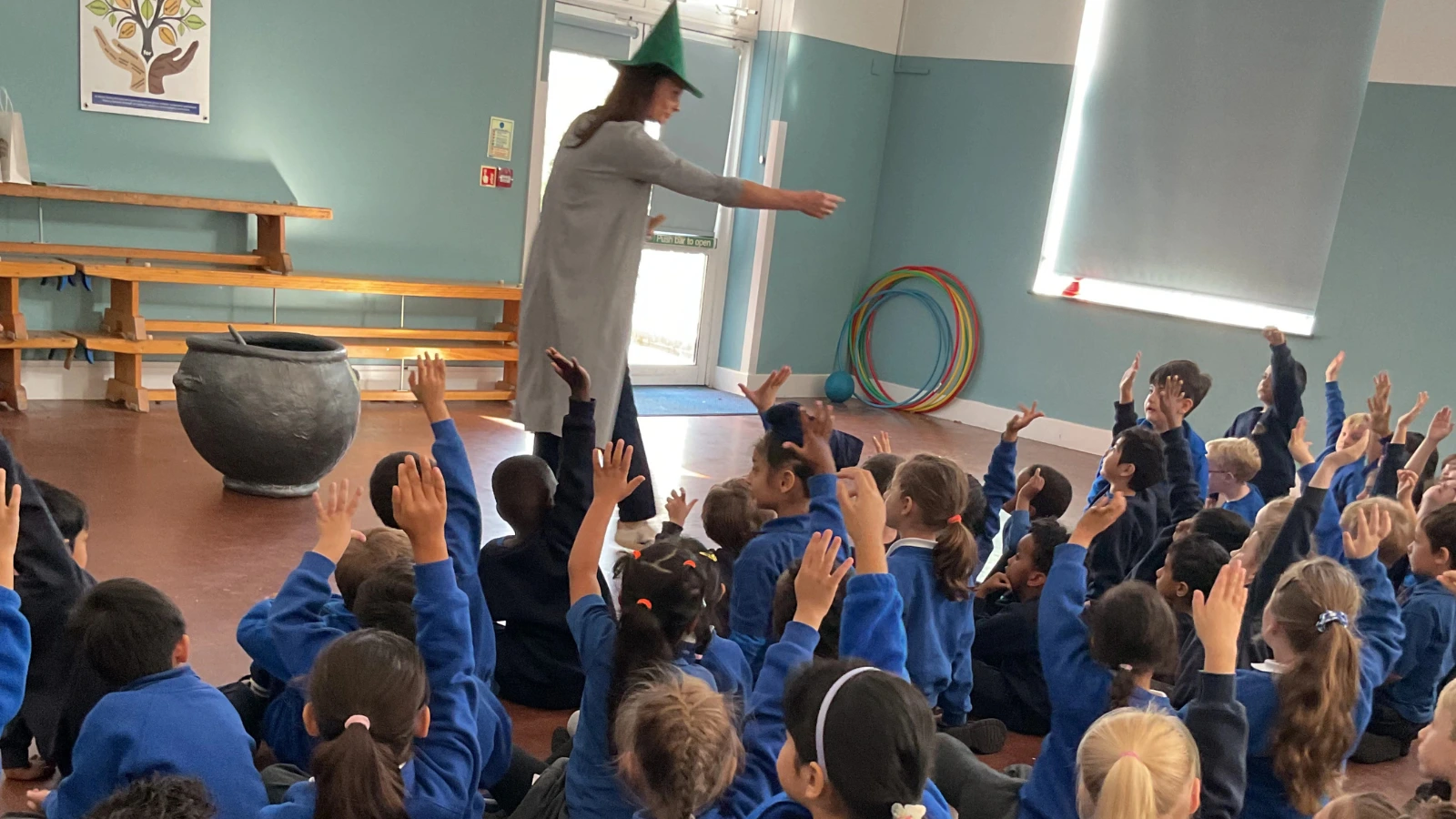
Image: Mel Scott-Avis delivering an interactive school author visit at London primary school
As we welcome in the new year, schools across the UK are being encouraged to take part in the National Year of Reading 2026, a campaign led by the Department for Education and the National Literacy Trust to help children, families and communities rediscover the joy of reading. It comes at an important moment: reading for pleasure has declined sharply among children and young people, with the Government reporting that, in 2025, only around one in three 8 to 18-year-olds said they enjoyed reading in their spare time.
For schools and early years settings, this raises a big question: how do we help children see books not simply as something they have to decode, but as something alive, playful, useful and full of possibility?
One evidence-backed answer is to bring authors into school. National Literacy Trust research shows that children who have experienced an author visit are more likely to enjoy reading and writing, and to feel confident in both. For schools, this makes an author visit much more than a special event. It becomes a practical way to build reading culture.
Author visits help children see books in a different light
For many children, especially in EYFS and KS1, the idea that a real person makes a book can feel almost magical. Ordinarily, books arrive in classrooms as finished objects. They sit in book corners, libraries and reading baskets. But when an author visits, children begin to understand that a story started as an idea. Someone imagined it, drafted it, changed it, drew it, read it aloud, made mistakes, tried again and eventually turned it into a book.
That matters pedagogically. The National Curriculum for English places strong emphasis on spoken language, explaining that it underpins children’s development “cognitively, socially and linguistically”. An author visit is rich in exactly this kind of language: children listen, respond, ask questions, predict, retell, role-play and make connections between the story and their own experiences.
For younger children, this is especially powerful. They are not just being told that books matter. They are seeing reading, writing and storytelling modelled in front of them by someone who uses those skills in real life.
Picture books are not 'just' stories
In early years and lower primary classrooms, picture books do a huge amount of work. They support vocabulary, listening, memory, narrative understanding, inference, emotional literacy and social development. The DfE’s Reading Framework highlights that book-related discussion introduces children to language they may not hear in everyday conversation and helps prepare them to become enthusiastic readers.
The research around shared book reading supports this. A meta-analysis by Dowdall et al. found that shared picture book interventions had positive effects on young children’s expressive and receptive language, especially when adults were supported to use book-sharing well.
Noble et al.’s meta-analysis also found evidence that shared book reading interventions can support children’s language development, although the authors are careful to note that the effect was smaller than some earlier reviews had suggested.
That caution matters. It reminds us that books are not magic objects in themselves. Their value in early education often lies in the shared experience around them: the adult-child talk, the pauses, the questions, the joining in, the vocabulary, the emotional connection and the chance for children to make meaning for themselves.
A good author visit should do exactly that.
Author visits turn reading into a shared event
Reading for pleasure is not built by worksheets alone. It grows through enjoyable, social experiences with books. Teresa Cremin and colleagues’ work on reading for pleasure pedagogy emphasises the importance of building communities of engaged readers, where book talk, choice, teacher knowledge of children’s literature and social reading practices all matter.
An author visit can become one of those memorable “reading community” moments. Children gather together around a story. They laugh at the same page. They wonder what might happen next. They ask why a character made a choice. They hear their teacher asking questions too. They see adults enjoying books, not just assessing them.
For EYFS and KS1, this shared experience is vital. Young children often enter stories physically and socially before they enter them analytically. They act them out. They repeat phrases. They copy voices. They notice tiny details in the pictures. They link the character’s problem to something that happened in the playground, at home, or in their own imagination.
The EYFS statutory framework recognises the value of this kind of imaginative engagement, including children making use of props and materials when role-playing characters in narratives and stories, inventing and recounting stories with peers and teachers, and performing songs, rhymes, poems and stories with others.
In other words, an interactive author visit is not a “nice extra”. Done well, it sits right at the intersection of communication and language, literacy, expressive arts, PSED and understanding the world.
Stories help children explore choices safely
One of the great strengths of picture books is that they allow children to explore big, sometimes challenging subjects at a safe distance. A character can make a mistake, tell a lie, feel jealous, feel left out, choose kindness, say sorry, or repair a friendship. Children can talk about that character before they have to talk directly about themselves.
This is particularly valuable in PSHE and early moral development. Research into socially themed picture book reading suggests that shared reading can support prosocial behaviour in preschool children, with empathy playing an important role in that process. Wider developmental research also links sympathy, moral motivation and prosocial behaviour in young children.
For teachers, this matters because stories can open up conversations that are otherwise hard to begin. “Was that a kind choice?” “How do you think the other character felt?” “What could they do next?” These are simple questions, but they invite children to practise perspective-taking, emotional vocabulary and problem-solving.
That is why picture books are such effective tools in the early years and primary classroom. They do not simply tell children what to think. They give them a safe, imaginative space to wonder, question and recognise feelings.
The evidence on author visits is encouraging
The National Literacy Trust’s 2023 research found a clear association between author visits and children’s reading and writing engagement. Children and young people who had experienced an author visit were more likely to say they enjoyed reading in their free time than those who had not, 58.6% compared with 39.3%. They were also more likely to say they enjoyed writing, 43.2% compared with 32.2%.
The same report is careful to say that we cannot conclude author visits directly cause these outcomes. That is an important distinction. But the link is still meaningful, especially because the positive association was particularly strong for children eligible for free school meals. Among pupils receiving FSM, 58.9% of those who had experienced an author visit said they enjoyed reading, compared with 36.1% of FSM pupils who had not.
Earlier National Literacy Trust research in 2019 found a similar pattern. Children who had experienced a writer visit reported higher levels of reading enjoyment, writing enjoyment and confidence in reading and writing than peers who had not.
For schools thinking about equity, this is worth pausing over. Author visits can give all children, including those with less access to books, bookshops, libraries or creative professionals outside school, a direct encounter with storytelling and authorship.
What makes an author visit valuable?
The best author visits are not passive assemblies where children simply sit and listen. They are interactive, responsive and age-appropriate.
- For EYFS, this might mean props, repetition, movement, joining in, expressive storytelling and simple emotional language.
- For KS1, it might include prediction, character choices, role-play, vocabulary, sequencing and discussion.
- For KS2, it can go deeper into writing process, illustration choices, editing, themes, audience, creative confidence and how stories are built.
Across all age groups, the key is connection. Children need to feel that the story belongs to them too. They need opportunities to answer, imagine, wonder, move, laugh and contribute.
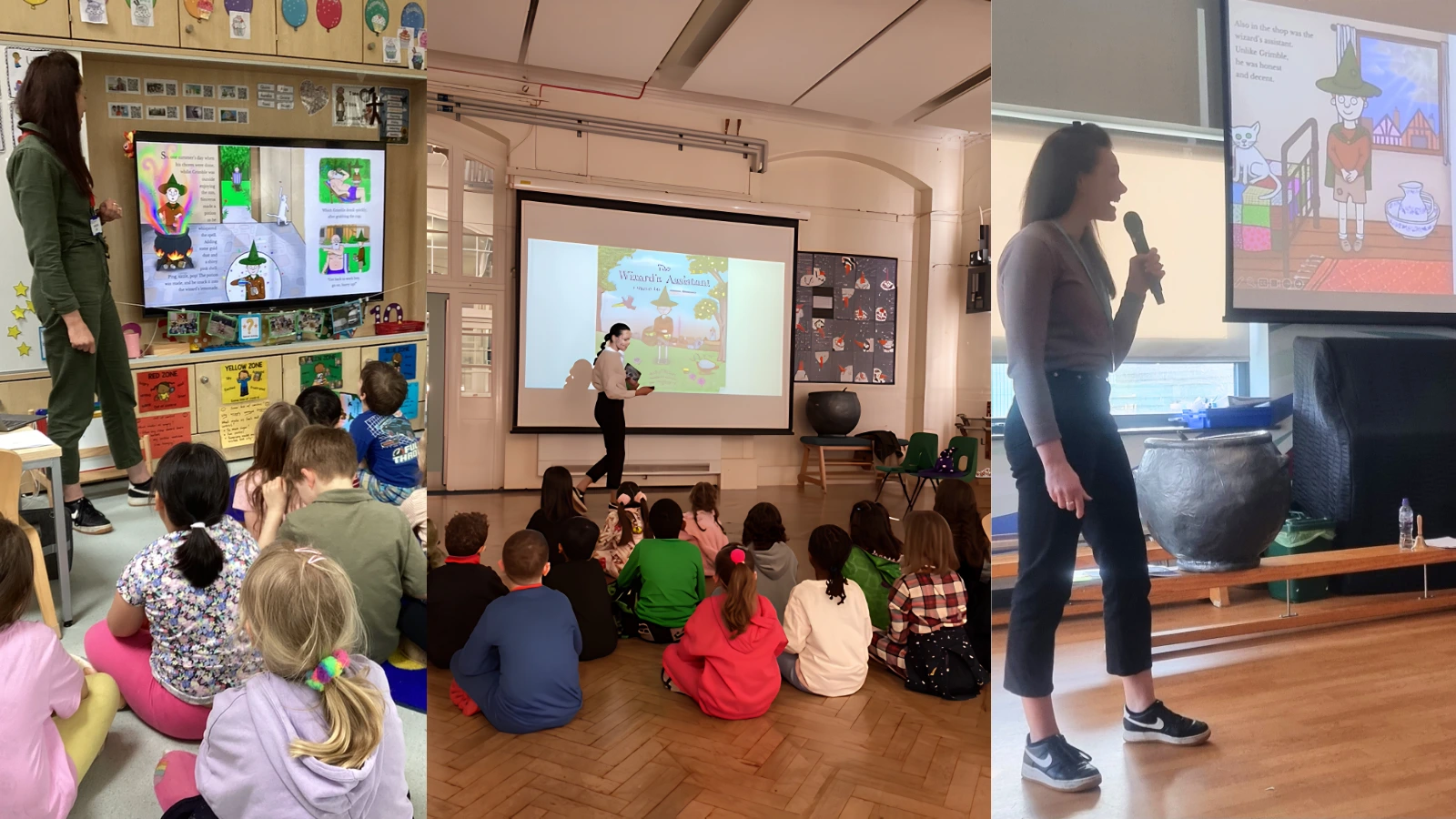
This is why I design my Mummy’s Fables visits around live storytelling, discussion, role-play and interactive activities. With The Wizard’s Assistant, for example, children explore ideas such as honesty, kindness, consequences, forgiveness and trust through a colourful rhyming story that gives them a character, a problem and a safe way into big conversations.
To help bring the story to life, I use life-sized props, playful games and plenty of opportunities for children to join in. These moments of participation help capture children’s attention, but more importantly, they give them a practical, memorable way to understand the messages within the story.
Author visits can support the National Year of Reading 2026
The National Year of Reading is not just about asking children to read more. It is about making reading visible, joyful, social and relevant. The Government’s campaign encourages children and families to “read into” the things they already love, whether that is football, comics, recipes, fantasy, blogs, audiobooks or picture books.
Author visits fit beautifully into that aim. They show children that reading is not confined to a reading record. Stories can become performances, conversations, drawings, games, choices, questions and memories. They can connect to feelings, friendships, families, food, magic, mistakes and the wider world.
And perhaps most importantly, author visits help children associate books with human connection.
For a young child, that can be the beginning of something lasting.
References
Clark, C. and Picton, I. (2023) Author visits in schools, and children and young people’s reading and writing engagement in 2023. London: National Literacy Trust. Available via the National Literacy Trust.
Clark, C. (2019) Writer visits and children and young people’s literacy engagement. London: National Literacy Trust. Available via the National Literacy Trust.
Cremin, T., Mottram, M., Collins, F. M., Powell, S. and Safford, K. (2014) Building Communities of Engaged Readers: Reading for Pleasure. London and New York: Routledge
Department for Education (2023) The Reading Framework: Teaching the Foundations of Literacy. London: Department for Education.
Department for Education (2025) Early Years Foundation Stage statutory framework for group and school-based providers. London: Department for Education.
Department for Education (2026) Premier League and literary greats back National Year of Reading. GOV.UK press release, 13 January 2026.
Dowdall, N., Melendez-Torres, G. J., Murray, L., Gardner, F., Hartford, L. and Cooper, P. J. (2020) ‘Shared picture book reading interventions for child language development: A systematic review and meta-analysis’, Child Development, 91(2), e383–e399.
Noble, C., Sala, G., Peter, M., Lingwood, J., Rowland, C. F., Gobet, F. and Pine, J. M. (2019) ‘The impact of shared book reading on children’s language skills: A meta-analysis’, Educational Research Review, 28, 100290.
Pillinger, C. and Vardy, E. J. (2022) ‘The story so far: A systematic review of the dialogic reading literature’, Journal of Research in Reading, 45(4), 533–548.
Whitehurst, G. J., Falco, F. L., Lonigan, C. J., Fischel, J. E., DeBaryshe, B. D., Valdez-Menchaca, M. C. and Caulfield, M. (1988) ‘Accelerating language development through picture book reading’, Developmental Psychology, 24(4), 552–559.
Chen, H., Zhang, Y., Li, X. and colleagues (2025) ‘The effectiveness of social-themed picture book reading in promoting children’s prosocial behavior’, Frontiers in Psychology, 16, article 1569925.